
Why Are Cash Buyers Taking Over Miami's Luxury Market? The $1M+ Boom
I want to talk about what's happening in Miami right now, because while the rest of the country is stuck in a mortgage rate paralysis, South Florida's luxury segment is operating in a completely different reality.
We're talking about a market where combined sales of homes priced above $1 million surged more than 21% year-over-year, with both single-family and condominium segments posting nearly identical increases. We're talking about a market that just posted its ninth consecutive month of annual sales growth in May 2026, with total residential sales in Miami-Dade County rising 7.9% from a year earlier to 2,064 transactions. And we're talking about a market where the buyers making all of this happen aren't waiting on the Fed, aren't watching mortgage rate headlines, and aren't losing sleep over 6.5% borrowing costs.
Because they're paying cash. And they're doing it at a scale that most people outside of South Florida simply haven't wrapped their heads around yet.
How Dominant Are Cash Buyers in Miami's Luxury Market Right Now?
Let me give you the numbers straight, because these are genuinely staggering.
More than 50% of properties valued at $1 million or more in Miami are being sold in cash. Properties between $1 million and $5 million are purchased in cash at a rate of 53.5%. Properties over $10 million: an impressive 59% are cash deals.
In May 2026, cash purchases represented 38.7% of all residential sales in Miami-Dade. Among existing condominium transactions, the cash share reached 49.7%.
For context, the national cash buyer average sits around 27%. Miami is running nearly 17 percentage points above that figure across all transactions, and even higher in the luxury tiers. Cash transactions account for 44% of all Miami-Dade closings overall, and at the $1 million-plus tier, cash buyers represent the clear majority. For properties above $10 million, more than 80% of transactions are completed in cash, reflecting the extraordinary financial profile of the buyers active in this segment.
This is not a trend. This is the new structural reality of how luxury real estate in Miami transacts. And it fundamentally changes everything about how this market behaves.
Who Is Actually Buying These Luxury Miami Homes?
This is the part of the story that explains why Miami keeps performing when logic says it shouldn't.
International buyers accounted for 52% of new-construction sales in late 2025, with Latin American purchasers from 73 countries comprising 86% of that activity. Domestic migration from high-tax states such as New York and California adds further demand depth.
Think about what that buyer pool actually looks like. You have a finance executive leaving Manhattan who just sold a $4 million co-op and is now shopping for a Brickell waterfront unit at $2.5 million, pocketing the difference and trading a state income tax bill for nothing. You have a Brazilian industrialist treating Miami as a dollar-denominated safe haven for capital that can't sit in reais. You have a Colombian family buying a Coral Gables estate as a generational asset and a passport hedge. You have a California tech founder relocating permanently after watching his state tax bill eclipse a million dollars in a single year.
Florida's lack of state income tax, strong connectivity to Latin America and Europe, and year-round climate continue to attract both domestic and foreign buyers. For many investors, the Miami property market offers a combination of income potential and global liquidity that few U.S. cities can replicate.
None of these buyers care about what the 30-year fixed rate is doing this week. They are moving capital, not taking on debt. And that is the engine underneath this entire market.
Why Has Miami Overtaken New York in $1M+ Home Sales?
This one surprised even me the first time I saw the data.
Miami overtook New York City in the number of $1 million-plus homes, evidence of an expanding luxury inventory and strong nationwide demand.
Let that sit for a moment. Miami. More million-dollar home transactions than New York City.
The relative value argument is the core explanation here. One million dollars buys significantly more prime residential space in Miami than in markets such as Monaco, New York, or London. For global investors seeking exposure to U.S. real estate with strong liquidity and international demand, this relative value remains compelling.
When a buyer can get a fully finished, amenity-rich condo with bay views in Edgewater for $1.2 million, or a four-bedroom home in Coconut Grove with a pool for $1.8 million, and do it without paying state income tax on the rental income or eventual sale proceeds, Miami stops looking expensive pretty quickly. It starts looking like one of the better-valued luxury markets on the planet.
Since 2011, median condominium prices in Miami-Dade have risen approximately 265%, while single-family home values have increased nearly 294%. The appreciation story is real, it's long-running, and it shows no signs of structural reversal.
What Is the Ultra-Luxury Segment Doing Right Now?
If the $1 million tier is booming, the tier above it is doing something that only a handful of markets on earth can claim.
South Florida continues to rank as the nation's leading ultra-luxury housing market, with the region averaging roughly one $10 million-plus home sale per day and setting multiple records for high-end transactions.
One $10 million home. Every single day. In South Florida.
$5 million-plus home sales also increased year-over-year, reflecting continued strength at the highest end of the market. And at the very top end, South Florida retains its position as the leading ultra-luxury condominium hub in the United States, recording its highest-ever number of $20 million-plus condo transactions in 2025, alongside near-record activity in the $10 million tier.
The branded residence trend is doing a lot of work in this tier specifically. Buyers at $10 million and above are increasingly drawn to developments attached to global hotel brands and luxury names that signal status, provide management services, and carry built-in international recognition. These are buyers who own properties in four or five countries and want the predictability that a branded product delivers.
Is There Any Distress in the Miami Market That Could Change This Picture?
This is a fair question to ask, and the answer is essentially no.
Distressed properties remain virtually absent from the market. Bank-owned homes and short sales accounted for just 0.2% of all transactions, a stark contrast to the aftermath of the financial crisis when distressed sales represented roughly 70% of Miami housing activity.
When you have a market that's 44% cash buyers, where the dominant buyer profile is a high-net-worth individual with no mortgage and strong equity positions in multiple assets, you simply don't get foreclosure pressure. There's no mechanism for it. These are not leveraged homeowners riding out a market they can barely afford. These are wealth preservation buyers. Distress is structurally absent from this segment.
For long-term investors and lifestyle buyers, Miami's fundamentals remain compelling: no state income tax, international demand, and limited supply in prime locations.
What Neighborhoods Are Driving Miami's $1M+ Boom?
The geography of the boom matters, because not all of Miami is behaving the same way.
Brickell, Downtown, Edgewater, Wynwood, and Coral Gables are core areas for buyers with different investment goals. Luxury entry prices start around $500,000 in central areas, with ultra-luxury concentrated in Coconut Grove and Bay Harbour Islands.
Waterfront properties continue commanding premium pricing with 5 to 8% annual appreciation. The most sought-after luxury communities include Miami Beach, Bal Harbour, Surfside, Coconut Grove, Coral Gables, Brickell, and South of Fifth.
Edgewater and the Upper East Side are the neighborhoods I'd be watching most closely if I were a buyer looking to get in front of appreciation. New development is actively transforming both corridors, and buyers who move in now are getting pricing that the next wave of projects will make look very good in three years. Coconut Grove remains the crown jewel for true estate living: limited supply, waterfront scarcity, and the kind of quiet prestige that serious money tends to prefer over flashy high-rises.
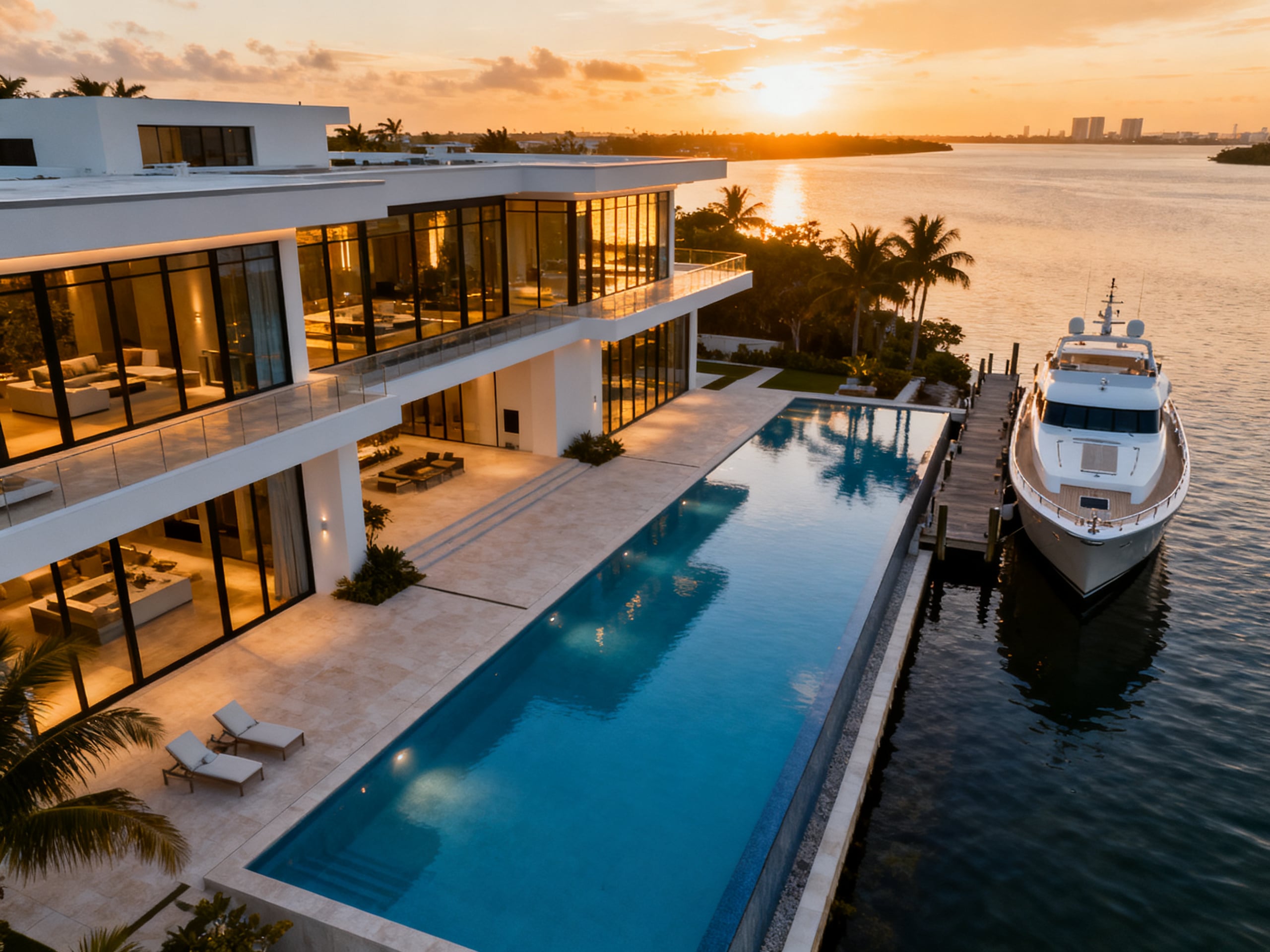
Waterfront homes in Miami-Dade County appreciated between 11 and 18% year-over-year in 2025. Demand for dock-access properties currently outpaces supply at a ratio of 4 to 1. The median waterfront sale price in Miami reached $4.58 million in 2025, driven by new construction closings in key coastal neighborhoods.
Four buyers for every dock-access listing. That is not a buyer's market. That is a structural supply problem that money alone cannot fix quickly.
What Does This Mean If You Are Thinking About Buying in Miami Right Now?
If you are a cash buyer or a buyer with significant liquidity, the fundamental thesis here is sound and the data backs it. You are buying into a market with genuine global demand, zero state income tax, one of the strongest appreciation histories in American real estate, and a structural supply constraint in the most desirable pockets that is not going away.
If you are a financed buyer entering the $1 million-plus tier, understand what you are competing against. Cash buyers represent the clear majority at the $1 million-plus tier, which fundamentally shapes negotiation dynamics in favor of prepared buyers. You need a pristine pre-approval, flexible terms, and ideally a seller situation where speed matters less than certainty of close.
And if you are sitting on the sidelines waiting for Miami luxury to soften the way the national market has softened, the data is telling you clearly that this segment operates by its own rules. The buyers who move this market are not rate-sensitive. They are not news-sensitive. They are wealth-preservation buyers with global alternatives, and right now they keep choosing Miami.
That tells you everything you need to know.