
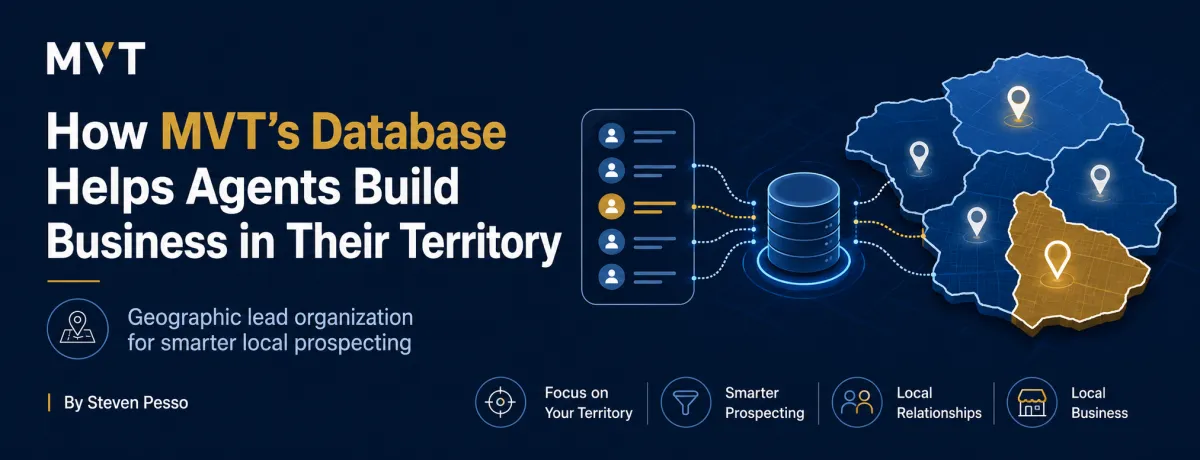
How MVT’s Database Helps Agents Build Business in Their Territory
After 11 years in real estate, one thing has become very clear to me: agents do not build a sustainable business simply by collecting more names and phone numbers.
They build it by knowing who they should be talking to, where those people are located, and how consistently they stay in touch.
That distinction matters.
I work in the Miami market as an Area Leader, and my experience includes property management as well as representing buyers and sellers. Working across those different sides of the business has shown me how local real estate really is. Two prospects can both be interested in Florida real estate and still need completely different conversations because they are looking in different communities, facing different market conditions, and pursuing different goals.
That is why I believe geographic organization inside a real estate database can be so valuable.
At MVT, the database is not something I look at as a giant list of people to call randomly. The real opportunity comes from approaching the database strategically, organizing your prospecting around the territory you actually know and serve.
A Database Is More Valuable When It Has Direction
Agents hear a lot about leads.
Get more leads. Generate more leads. Find another lead source.
But adding more people to a database does not automatically create more business.
The question I think agents should ask is:
What am I doing with the opportunities I already have access to?
A database becomes much more useful when an agent stops viewing every contact as identical.
Geography gives you one practical way to create focus.
If I serve Miami, my most productive conversations are naturally going to come from people who have a connection to the areas where I can provide real value. I understand the communities. I understand how different neighborhoods can appeal to different buyers. I understand many of the questions local homeowners, investors, landlords, buyers, and sellers are likely to ask.
That local knowledge makes the conversation stronger.
Instead of approaching prospecting as, "Who can I call today?" an agent can begin thinking:
"Who in my market should I be building a relationship with today?"
That is a much better question.
Your Territory Gives Your Prospecting a Purpose
One challenge agents face is trying to be everything to everyone.
Real estate can make that tempting. There is always another city, another ZIP code, another neighborhood, and another potential client.
But trying to cover too much territory can make your prospecting less personal.
When you concentrate on the markets you genuinely serve, you can speak with greater confidence and relevance.
You know what buyers tend to ask.
You know what sellers are concerned about.
You understand the communities people are comparing.
You can talk intelligently about property types, location considerations, ownership goals, and the practical realities of working within that market.
For me, Miami is not simply a location attached to my profile. It is the market where I am building relationships and serving clients.
That is how I believe agents should think about territory.
Your territory is not just an area on a map. It is the place where your knowledge can become useful to another person.
Geographic Organization Helps Turn a Large Database Into Manageable Conversations
A large database can feel overwhelming.
When an agent sees hundreds or potentially many more contacts, it is easy to start calling without much strategy or, even worse, avoid prospecting because the list feels too large.
Geographic organization changes the way you can look at that information.
Rather than thinking about the entire database at once, you can narrow your attention to the people who are relevant to the market you serve.
That creates a much more manageable prospecting process.
An agent might focus on one community, part of a county, or another defined portion of their territory and work through those relationships consistently.
The goal is not to blast everyone with the same message.
It is to create better conversations.
Someone interested in a specific part of Miami should hear from an agent who can speak intelligently about that area, not someone treating them like another record in a CRM.
That difference is important.
Local Knowledge Makes Follow-Up Better
One of the biggest advantages of territory-focused prospecting is that follow-up becomes easier to personalize.
Consider the difference between these two approaches.
The first is a generic call:
"Are you still interested in buying or selling real estate?"
The second begins with an understanding of where the person is actually interested in doing business.
Now the agent has context.
That context can lead to a useful conversation about what the person is looking for, what has changed in their plans, what type of property they are considering, or what questions they currently have about the local market.
That is not about using a clever sales script.
It is about being relevant.
In my experience, people respond differently when they realize you understand the area they care about.
Real estate is a relationship business, and relevance helps relationships develop.
Prospecting Should Be Consistent, Not Random
The database itself is only a tool.
An agent still has to use it.
I think this is an important point because technology can sometimes create the impression that the system will build the business for you.
It will not.
Agents still have to make calls.
They still have to follow up.
They still have to have conversations.
They still have to learn their markets.
They still have to stay organized.
What a geographically organized database can do is give that activity more direction.
Instead of waking up and wondering who to contact, you can work a defined portion of your market and continue building familiarity with the people connected to it.
Over time, that creates discipline.
And discipline matters far more than having one great prospecting day followed by two weeks of silence.
Your Database Can Also Help You Learn Your Territory
There is another benefit that agents sometimes overlook.
Prospecting a defined geographic area can teach you more about your own market.
The more conversations you have with people interested in a particular community, the more you begin hearing recurring questions and concerns.
What are buyers confused about?
What are homeowners thinking about?
What keeps coming up in conversations?
Where do prospects need more education?
Those conversations can help an agent identify areas where they need to improve their own knowledge.
That makes prospecting more than a search for immediate business. It becomes part of your professional development.
I have been in this industry for 11 years, and I still believe agents have to keep learning.
Real estate continues to become more sophisticated and challenging. Consumers have access to more information, more technology, and more choices than ever before.
Simply having a real estate license is not enough.
We need to understand the business and the communities we serve well enough to help people make informed decisions.
You Do Not Need to Chase Every Market
This may be one of the most important lessons for agents who are trying to grow.
You do not necessarily need to chase business everywhere.
Sometimes the stronger opportunity is to go deeper where you already have knowledge.
Know your territory.
Understand the people in it.
Organize your prospecting.
Follow up consistently.
Become more useful with every conversation.
For agents using the MVT database, I believe that is the real value of geographic organization. It helps turn a broad collection of opportunities into a focused market where an agent can actually build relationships.
The database provides structure.
Your local knowledge gives that structure meaning.
And your consistency is what turns those conversations into a real business.
As Miami's Area Leader, that is the approach I want agents to understand. Do not look at a database and see a mountain of names. Look for the people in the communities you are equipped to serve, then start building genuine relationships there.
If you are an agent who wants a more organized approach to prospecting and business development, I would be happy to have a conversation about how we approach it at MVT.