
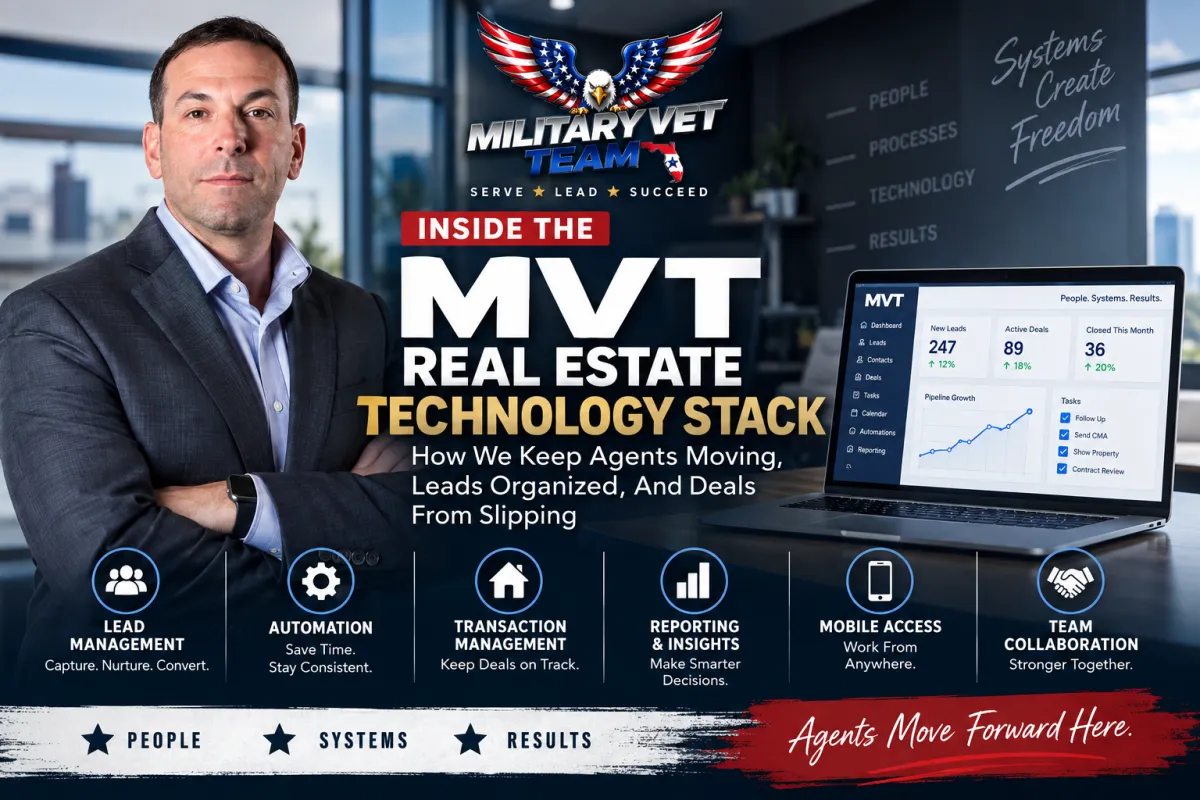
Inside The MVT Real Estate Technology Stack: How We Keep Agents Moving, Leads Organized, And Deals From Slipping
Why Does A Real Estate Team Need A Technology Stack In 2026?
A real estate team needs a technology stack because the business has too many moving parts for memory, sticky notes, and scattered text threads. Leads, clients, lenders, showings, listing tasks, marketing requests, recruiting, and follow-up all have to move through one system, or things get missed.
I’ll say it straight. Talent matters, but talent without systems gets messy fast.
I’ve been in real estate for 11 years, and I’ve watched the industry get more sophisticated every single year. Buyers know more. Sellers expect more. Agents have more platforms hitting them from every direction. Mortgage files require cleaner documentation. Condo deals in Miami can turn complicated overnight because of association rules, insurance questions, reserves, or financing review.
That’s why the MVT real estate technology stack matters.
It’s not just a bunch of apps. It’s the way we keep communication, lead follow-up, prospecting, marketing, lending conversations, and admin support connected. Slack keeps the team moving. Follow Up Boss keeps the database accountable. YLOPO helps create and nurture online opportunities. AI platforms help agents produce, research, summarize, and move faster. Prospecting systems keep agents from hiding behind busywork. Administrative tools keep requests from getting buried.
A few weeks ago, I was between showings in Brickell when a buyer asked me about monthly payment, condo fees, and whether the building might create financing issues. My phone was buzzing, Slack was moving, and Follow Up Boss had the full lead history. That’s the real world. You don’t get a quiet office and three hours to figure everything out. You need a system that works while the day is already moving.
How Does Slack Keep The Team From Getting Buried?
Slack keeps the team from getting buried by turning scattered communication into organized channels, fast updates, and searchable conversations. Instead of every question living in one long group text, the team can separate operations, marketing, training, recruiting, deals, and urgent requests.
That sounds simple until you’ve lived the opposite.
Without Slack, one agent texts one person, another agent sends a DM somewhere else, somebody drops a file in email, and a marketing request gets lost between lunch and the next showing. That’s not a team. That’s noise.
At MVT, Slack works like the live command center. Channels keep topics separated. DMs handle quick one-to-one questions. Huddles let people jump into real-time working sessions when typing back and forth would slow things down. Slack describes huddles as a way to work live inside a channel or direct message with video, screen sharing, and a thread for notes, which is exactly why they fit a real estate team that needs quick problem-solving.
I like Slack because it protects speed.
If a Miami buyer wants to see a condo near Edgewater, I need communication fast. If an agent needs a flyer corrected before an open house, the request needs to land where the right people can see it. If leadership is rolling out a training update, it should not depend on someone remembering to forward an email.
The best teams don’t just communicate more. They communicate cleaner.
Why Is Follow Up Boss The Core Of The Database?
Follow Up Boss is the core of the database because every lead, contact, stage, note, task, call, text, and follow-up plan needs a home. If Slack is where the team talks, Follow Up Boss is where the client relationship gets tracked.
I’m dual-licensed, so I see how dangerous messy data can be.
As a loan officer, here’s what I see in the file. I see whether the buyer is actually ready, what documents are missing, what payment range makes sense, and where the friction might come from. As your agent, here’s what I do about it. I make sure the lead is not treated like a random name in a phone. I want context. I want the timeline. I want notes. I want the next step.
Follow Up Boss is built around that kind of accountability. Its own help center explains Smart Lists as filtered lists that help agents know who to call daily and keep leads from slipping through the cracks. It also describes Action Plans as tools that can automatically send drip emails, assign tasks, and support follow-up workflows.
That matters because real estate follow-up is not one call.
A buyer in Kendall might not be ready today because the payment feels tight. Three months later, the numbers may look better. A seller in Coral Gables might be curious now and serious after school starts. An investor looking at Little Havana might go quiet, then reappear when a tenant situation changes. If those people are not organized, the agent loses opportunity.
One morning, I pre-approved a buyer before 10 AM, showed him two options in Doral that afternoon, and updated the notes before dinner so the next conversation had context. That’s not glamorous. That’s how deals stay alive.
Where Does YLOPO Fit In The MVT System?
YLOPO fits into the MVT system by helping create, engage, and nurture digital real estate opportunities before they become live conversations for agents. It supports the front end of the lead journey, especially when buyers and sellers are searching online long before they are ready to raise their hand.
Most consumers do not wake up and say, “I’m ready to buy today. Please assign me to an agent.” They browse. They click. They save homes. They ask quiet questions. They compare neighborhoods. In Miami, they might look at Brickell condos one night, Doral townhomes the next day, and Miami Beach listings after that.
YLOPO’s public materials describe its platform as real estate lead generation with AI follow-up, including AI agents that find, engage, and qualify buyers and sellers around the clock. Its help center also describes AI Text as working across the lead database, from new registrations to older leads that went quiet.
That is valuable, but only if the agent still does the real work.
AI can start a conversation. A platform can identify behavior. A text can wake up a quiet lead. But when someone is ready to talk about payment, timing, inspection risk, condo financing, or selling strategy, a real professional has to step in.
This is where I think MVT’s stack gets powerful. YLOPO can help create signal. Follow Up Boss can hold the history. Slack can alert the team. The agent can bring judgment.
That last part cannot be automated.
How Do AI Platforms Help Without Replacing The Agent?
AI platforms help by speeding up research, writing, summarizing, planning, and content creation, but they do not replace the agent’s judgment. The best use of AI in real estate is not to sound smart. It’s to move faster while staying accurate.
That line matters.
I do not want agents using AI to fake expertise. I want them using AI to organize what they already know, prepare better client education, summarize notes, draft cleaner market explanations, build social content, and turn training into usable action.
For example, if an MVT agent just watched a mentorship session about Follow Up Boss Smart Lists, AI can help turn that into a checklist. If a team leader records training on prospecting, AI can help create a recap, carousel copy, video script, or agent handout. If a Miami buyer asks about the difference between HOA dues and assessments, AI can help draft the first version of an explanation, but the agent still has to verify the answer and make it local.
I use the same thinking in my own business. If I’m writing about Miami mortgage rates, I’m not going to let AI invent numbers. If I’m explaining a condo association issue, I’m not going to let a tool guess. I use technology to get organized, then I apply experience.
That’s the standard.
AI should make agents sharper, not lazier.
Why Do Prospecting Systems Still Matter If We Have Automation?
Prospecting systems still matter because automation can create reminders, but it cannot build relationships for you. The agent still has to call, text, follow up, ask better questions, and stay consistent when the lead is not ready today.
This is where a lot of agents fool themselves.
They think having a CRM means they are prospecting. They think having AI text means the relationship is handled. They think a lead source means opportunity is guaranteed. It does not work that way.
A prospecting system is the daily discipline that turns the stack into production.
That means working Smart Lists. Calling hot leads. Reconnecting with nurture leads. Following up after open houses. Reaching out to past clients. Checking in with landlords. Tracking seller conversations. Looking at who opened, clicked, replied, or came back to the site.
Follow Up Boss itself talks about Smart Lists as a daily follow-up tool, and that is exactly how agents should treat them. The system can point. The agent has to move.
I’ve had leads go quiet for months, then come back because the timing finally lined up. I’ve had buyers who were not ready in March become very serious by August. I’ve had sellers who needed three real conversations before they trusted the pricing strategy.
If those people are not in a system, you are hoping they remember you.
Hope is not a business plan.
How Do Administrative Tools Protect Agents From Losing Time?
Administrative tools protect agents by turning requests, tasks, files, onboarding steps, marketing needs, and support questions into trackable work instead of random interruptions. The goal is not to add more software. The goal is to reduce confusion.
Real estate agents already have enough coming at them.
A listing needs photos. A flyer needs edits. A business card needs updating. A new agent needs onboarding. A lead route needs checking. A marketing folder needs the right files. A transaction needs documents. A client needs an answer. A lender needs an update.
If every request arrives through a different door, the team wastes time figuring out where things are. That is why administrative tools matter. Ticketing systems, shared drives, onboarding docs, task boards, calendars, forms, templates, and standard operating procedures are not boring. They are the back office that keeps agents selling.
One of the best things a team can do is make the right action easy.
If an agent needs a marketing request, there should be a clear path. If a new agent needs tech setup, there should be a checklist. If leadership wants to track recurring issues, the requests should be organized enough to show patterns.
That is how a team gets better.
What Happens When The Stack Actually Works Together?
When the stack works together, the agent gets clarity instead of chaos. Leads come in, conversations are tracked, follow-up is assigned, marketing support moves, team communication stays visible, and leadership can see where people need training.
Here’s what that looks like in real life.
A buyer lead comes through a digital source. YLOPO helps engage. Follow Up Boss captures the contact, source, activity, notes, and tasks. The agent gets the follow-up cue. Slack keeps the right team members connected if something needs support. AI can help summarize a call or draft a quick educational follow-up. Administrative tools handle the request if the agent needs a flyer, landing page, open house package, or onboarding help.
That is not magic. That is plumbing.
And in real estate, plumbing matters.
The client does not care which tool did what. They care that someone called back, understood their situation, explained the next step, and did not lose the thread. The agent does not need ten disconnected tabs. The agent needs one operating rhythm.
For MVT, the bigger point is culture. The technology stack is not there to make agents feel watched. It is there to make agents more supported, more consistent, and more dangerous in the market.
When the tools work and the agent works, the client feels the difference.
Quick Questions Agents Ask About The MVT Technology Stack
Do agents need to master every tool on day one?
No. Agents need to understand the workflow first, then build skill inside each platform. Start with communication, lead follow-up, daily prospecting, and where to ask for help.
Does automation replace personal follow-up?
No. Automation supports personal follow-up, but it does not replace it. Real estate is still a trust business, especially when money, timing, family, and financing are involved.
What is the biggest mistake agents make with tech?
The biggest mistake is treating tools like storage instead of action systems. A CRM full of untouched leads is not a system. It is a graveyard with login credentials.
What Is The Real Point Of The MVT Stack?
The real point of the MVT stack is to help agents move faster, follow up better, stay organized, and serve clients with more confidence. The tools matter, but the behavior behind the tools matters more.
I see this from both sides of my business.
As a Miami realtor, I know what it feels like when a client needs an answer now. As a mortgage loan officer, I know how one missing detail can slow down a file. As an area leader, I know agents need training, structure, and support if they are going to grow in this market.
The MVT technology stack works because it connects the real parts of the business. Slack for communication. Follow Up Boss for database accountability. YLOPO for digital lead generation and nurture. AI platforms for speed and content support. Prospecting systems for daily production. Administrative tools for the details that keep the machine from breaking.
That is the overview.
But here is the truth. No platform saves an agent who refuses to follow up. No AI tool fixes a weak work ethic. No CRM closes deals by itself.
The agents who win are the ones who use the stack, trust the process, and still pick up the phone.
If you are an agent who wants more than a logo over your head, you need systems behind you. That is what we are building inside MVT. And if you want to understand how this stack could help you run a cleaner, sharper real estate business, reach out. I’ll show you how the pieces work together.