
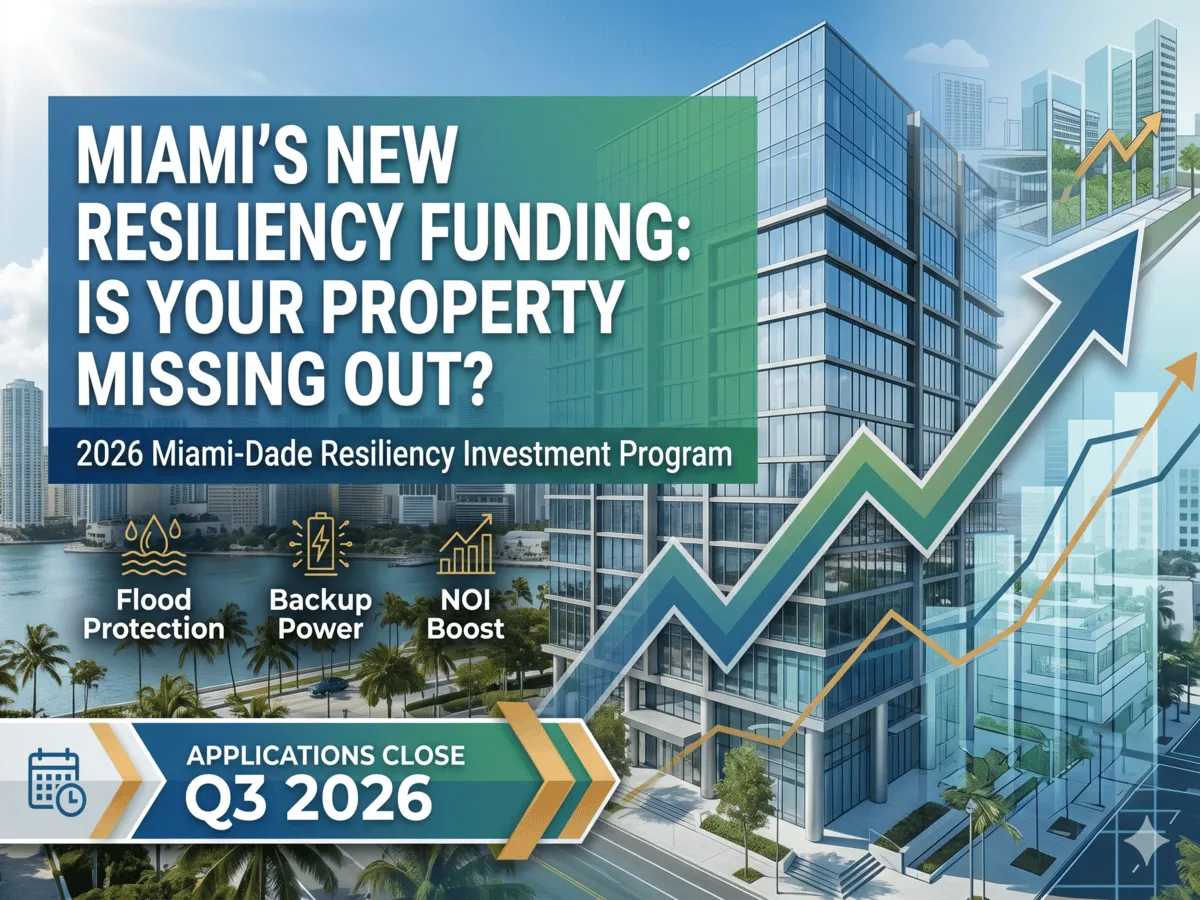
Miami's 2026 Resiliency Funding Explained: How Property Owners Can Protect NOI and Asset Value
Miami's new resiliency funding program is live. And most commercial property owners are missing it.
Here's the reality: insurance costs in South Florida jumped 40% over the past three years. Flood risk is getting priced into everything. Cap rates are compressing in resilient assets while vulnerable properties sit on the market.
The 2026 Miami-Dade Resiliency Investment Program changes the math for property owners who move fast.
Let me break down exactly what this means for your NOI, your insurance premiums, and your asset valuation.
What the 2026 Resiliency Funding Actually Covers ?
Miami-Dade County allocated $127 million for commercial property resilience upgrades this fiscal year. This builds on the Miami Forever Bond and targets properties in high-exposure flood zones.
The program covers:
Flood mitigation infrastructure — elevation systems, flood barriers, stormwater management
Backup power systems — generators, battery storage, solar integration
Building envelope hardening — impact-resistant glazing, roof reinforcement
Green infrastructure — permeable surfaces, bioswales, living shorelines
Grants cover 50-75% of project costs depending on property location and flood zone classification. Maximum award: $2.5 million per property.
The catch? Applications close Q3 2026. First-come allocation until funds run out.
The Direct NOI Impact Most Owners Miss
Here's where the funding program creates immediate value.
Insurance premium reduction. Properties with documented resilience upgrades see 15-25% lower premiums from carriers still writing in South Florida. That's not speculation — that's what insurers are telling underwriters right now.
On a $50,000 annual premium, that's $7,500-$12,500 back to NOI. Every year.
Operational continuity. Backup power keeps tenants operational during outages. That matters for lease renewals. It matters for tenant retention. And it matters when you're competing for credit tenants who now include business continuity in their site selection criteria.
Reduced vacancy risk. Climate-vulnerable properties in Miami are experiencing 200+ basis points higher vacancy than resilient competitors. The funding program lets you close that gap without bearing full upgrade costs.
How This Affects Asset Valuation ?
Institutional buyers are running climate risk models on every Miami acquisition.
They're looking at:
FEMA flood zone classification
Historical loss data
Building resilience features
Insurance availability and cost trajectory
Properties without documented resilience improvements are getting haircuts at the valuation stage. Or they're not getting offers at all.
The 2026 funding program creates a paper trail that buyers want to see:
County-verified resilience assessment
Documented infrastructure upgrades
Third-party certification of improvements
Ongoing maintenance protocols
This documentation travels with the asset. It becomes part of the due diligence package. And it directly supports cap rate compression when you exit.
The Application Strategy That Works
Most applicants make the same mistake: they apply without connecting upgrades to documented risk reduction.
Here's the approach that gets funded:
Start with a resilience audit. Miami-Dade has approved third-party assessors who produce reports the county actually uses in allocation decisions. Get the audit before you apply.
Prioritize projects with measurable outcomes. Elevation projects that move you to a lower flood zone. Generator capacity that covers 100% of critical systems. Stormwater management that handles 25-year storm events.
Document the insurance impact. Get a letter from your broker projecting premium reduction based on proposed improvements. Include it in your application.
Show the NOI math. The county wants to fund projects that keep commercial properties viable and tax-generating. Show them the before/after NOI impact.
What Happens If You Wait
The funding runs out. That's the simple version.
The complex version: every quarter you delay, insurance carriers are repricing South Florida risk. Properties without resilience features are becoming harder to insure at any price. And buyers are building climate risk into their models with increasing precision.
The 2026 program creates a window. County funding covers 50-75% of costs that you'd otherwise bear entirely. Insurance savings compound annually. And documented improvements support valuation at exit.
That window closes when allocation runs out.
Miami's 2026 resiliency funding isn't a subsidy program. It's a capital stack opportunity.
Property owners who move now lock in:
Reduced insurance costs that flow directly to NOI
Documented resilience features that support valuation
County-verified improvements that satisfy institutional buyer due diligence
Competitive positioning against vulnerable assets
The math works. The timing is tight.
If you own commercial property in Miami-Dade flood zones, this program deserves a hard look before Q3 closes.