
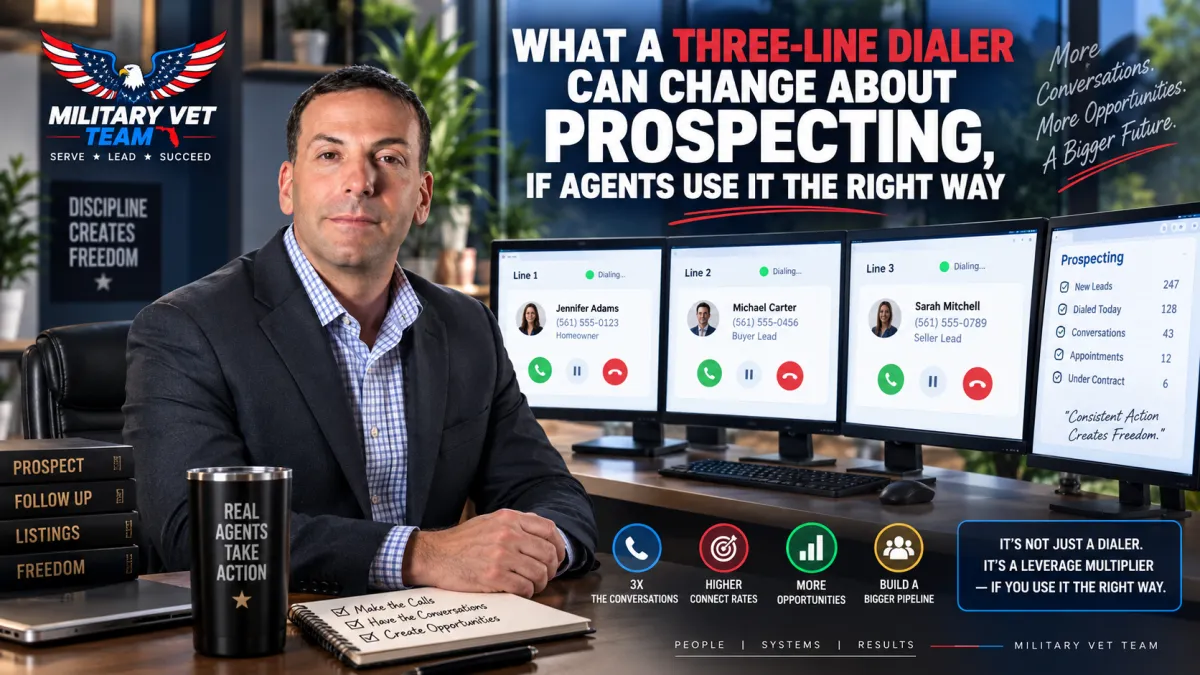
What A Three-Line Dialer Can Change About Prospecting, If Agents Use It The Right Way
Why Are Agents Talking About Three-Line Dialers Again?
Agents are talking about three-line dialers because prospecting time is getting more expensive, attention is harder to earn, and follow-up has to be more organized than ever. A three-line dialer can help an agent make more outbound attempts in less time, but only when the list, script, CRM notes, and compliance rules are tight.
I’ll say the part most agents don’t want to hear. The dialer is not the magic. The discipline is.
A three-line dialer can call multiple numbers at once and connect the agent when a live person answers. That can reduce dead time. It can help agents move through bigger lists. It can make prospecting feel less painful because you are not manually dialing one number, waiting through rings, hitting voicemail, hanging up, typing a note, then starting over.
But if your list is messy, your notes are lazy, your follow-up is weak, or your compliance process is loose, the dialer only helps you create problems faster.
I’ve been in real estate for 11 years, and I’ve watched agents blame tools for things that were really habits. The CRM didn’t fail. The agent didn’t work the CRM. The lead source didn’t fail. The follow-up was inconsistent. The dialer didn’t fail. The list was cold, unorganized, and not cleaned properly.
At MVT, the bigger conversation is not, “Can this tool make more calls?” The better question is, “Can this tool help a trained agent have more real conversations with the right people, inside a system that protects the consumer and the business?”
That is the standard.
Last week, I was between a financing conversation and a showing near Doral, and an agent asked me if a three-line dialer would fix his prospecting problem. I asked him what list he was calling. He paused. That pause told me everything.
What Does A Three-Line Dialer Actually Change?
A three-line dialer changes the amount of dead time between live conversations. It does not automatically make an agent better, but it can make a prepared agent more efficient.
Manual dialing is slow. You look up the contact. You dial. You wait. You hit voicemail. You leave a message or don’t. You log the call. You move to the next one. Multiply that by 100 attempts and you can lose a lot of time to silence.
A three-line dialer compresses that process. It can place multiple outbound calls at once and route the live connection to the agent. The goal is simple. Spend less time listening to rings and more time talking to people.
That matters because real estate is still a contact sport.
AI can help draft. Follow Up Boss can organize. YLOPO can generate and nurture. Slack can move information quickly. But deals still happen when an agent asks the right question at the right time.
A buyer in Kendall might not reply to a text but may answer a call after work. A seller in Coral Gables may ignore three emails but pick up when they recognize the area code. An investor looking at Little Havana might need a direct conversation before they understand the numbers. The phone is not dead. Bad phone work is dead.
A dialer can help with efficiency, but efficiency without judgment gets dangerous. If you speed up weak prospecting, you just annoy more people faster.
How Can A Three-Line Dialer Improve Contact Rates?
A three-line dialer can improve contact rates by increasing the number of call attempts during a focused prospecting block. More attempts can create more chances for live conversations, but only if the list is relevant and the calling process is consistent.
There is a big difference between calling 30 random contacts and calling 120 organized contacts with a reason.
That reason might be a new listing in their area. It might be a saved search they opened. It might be a past buyer check-in. It might be a seller lead who asked for a valuation months ago. It might be a landlord who owns a Miami investment property and needs an updated rental number.
The best agents don’t just ask, “Who can I call?” They ask, “Why does this call make sense today?”
That is where list organization becomes everything.
If the list is made of old internet leads with no segmentation, you are guessing. If the list is grouped by behavior, source, timeline, location, and previous conversation, you are prospecting with purpose.
As a loan officer, here’s what I see in the file. Timing matters. A buyer who was not ready three months ago may be ready now because debt changed, income changed, or rates moved. As your agent, here’s what I do about it. I don’t just let that buyer sit in the database. I want a follow-up system that brings that person back to the surface.
A dialer helps when the CRM tells you who deserves the call.
Why Does List Organization Matter More Than The Dialer?
List organization matters more than the dialer because the quality of the people you call controls the quality of the conversations you have. A three-line dialer can move quickly, but it cannot decide for you who should be called, why they should be called, or what the next step should be.
This is where agents either level up or waste a tool.
A good prospecting list should be segmented. Hot buyers. Cold leads. Past clients. Open house visitors. Expired search activity. Seller valuation leads. Investors. Landlords. Renters who may be close to buying. Miami condo buyers who need financing education. Homeowners in a farm area who may respond to a local market update.
Different lists need different scripts.
You do not call a past client the same way you call an old internet lead. You do not call a landlord the same way you call a first-time buyer. You do not call a Brickell condo lead the same way you call a family looking in West Kendall.
One morning, I reviewed a list with an agent who had hundreds of names and almost no useful notes. Some contacts had no source. Some had no timeline. Some had no property preference. Some had been called before, but nobody wrote down what happened. That is not a database. That is a junk drawer.
The dialer was not the problem. The data was.
Good list organization tells the agent what to say. It gives the call context. It makes the follow-up cleaner. It protects the client experience because nobody wants to be called by someone who has no idea why they are calling.
How Should Follow Up Boss And A Dialer Work Together?
Follow Up Boss and a dialer should work together by keeping every call connected to the lead record, notes, tasks, stage, source, and next step. The dialer creates the attempt. The CRM creates the memory.
That is the part agents cannot skip.
If you call 100 people and don’t log what happened, you did not prospect professionally. You just made noise. The value of the call is not only the conversation. It is the information that helps the next conversation get better.
Did they answer? Did they say call back next month? Did they say they already bought? Did they ask about Miami mortgage rates? Did they mention moving from New York? Did they say they are waiting for their lease to end? Did they ask about selling a condo in Edgewater? Did they say never call again?
That last one matters, and we are going to talk about it.
A strong prospecting workflow should create a loop. List pulls from Follow Up Boss. Dialer runs the session. Agent has the conversation. Notes go back into Follow Up Boss. Tasks get created. Stages get updated. Follow-up reminders are set. People who opted out are handled correctly.
This is how a database becomes a business asset.
At MVT, our technology stack only works when the pieces talk to each other through agent behavior. Slack helps the team communicate. Follow Up Boss keeps the record. YLOPO can help bring online activity into focus. AI can help summarize or prepare. Prospecting systems create the daily action. Administrative tools keep the back end from turning into chaos.
The dialer is one part of that machine.
What Should Agents Say When They Finally Get Someone Live?
Agents should say something relevant, short, and human when someone answers. The goal is not to trap the person on the phone. The goal is to earn the next few seconds.
A three-line dialer can create more live answers, but that becomes a problem if the agent sounds robotic.
Do not open with a paragraph. Do not pretend you are best friends. Do not act shocked that someone answered. Be clear.
For example, if I’m calling a buyer lead who was looking in Doral, I might say something like, “Hey, this is Steven Pesso. I saw you were checking out a few homes around Doral, and I wanted to see if you were still browsing or if you had a timeline in mind.”
That is simple. It gives context. It lets them answer honestly.
If I’m calling a landlord, the opening changes. “Hey, this is Steven Pesso. I work with Miami property owners, and I was checking in because rental numbers and carrying costs have shifted. Are you still holding that property, or have you thought about making a move?”
Different list. Different reason. Different conversation.
The best call sounds like it belongs in that person’s day. The worst call sounds like the agent is reading from a script written for everybody and nobody.
What Compliance Rules Should Agents Respect Before Using A Dialer?
Agents should respect federal, state, brokerage, platform, and team rules before using any dialer. Calling laws can involve the National Do Not Call Registry, company-specific do-not-call lists, consent requirements, calling-hour restrictions, prerecorded or artificial voice rules, and state-level requirements.
I’m not your attorney, and this is not legal advice. But I am serious about this part.
The FTC explains that the Telemarketing Sales Rule gives consumers protections through the National Do Not Call Registry, and its business guidance says the TSR does not preempt state law, meaning businesses may still need to check state requirements too. The FTC also states that calling a number on the registry can be unlawful unless an exception applies, such as an established business relationship or written agreement to be called. The TCPA also covers areas like autodialed calls, prerecorded or artificial voice calls, telemarketing calls, and related requirements.
That means agents need a process before they start clicking buttons.
Scrub lists. Respect opt-outs. Know calling windows. Avoid calling people who should not be called. Understand consent. Follow brokerage policy. Keep records. When someone says stop calling, stop calling and update the system.
A three-line dialer is a power tool. You do not use a power tool without rules.
And for real estate teams, this is not only about avoiding fines or complaints. It is about brand trust. Nobody wants to work with an agent who treats people like numbers.
How Does A Dialer Help Newer Agents Build Confidence?
A dialer can help newer agents build confidence by forcing repetition, reducing dead time, and creating more chances to practice real conversations. Confidence comes from reps, not from thinking about calling.
New agents often make prospecting too emotional.
They stare at the list. They rewrite the script. They check Instagram. They make three calls and decide nobody answers. Then they say prospecting does not work.
No. Prospecting did not happen long enough to work.
A structured dialer session changes that. You set the list. You set the time block. You know the reason for the call. You make the calls. You log the results. You schedule the follow-up. Then you review what happened.
That rhythm matters.
I tell agents to stop judging the session by one rude person or one awkward call. Judge the session by the activity, the conversations, the notes, and the pipeline created. Some calls are not going to feel good. That is part of the job.
Miami moves fast. Buyers get distracted. Sellers get nervous. Investors overthink. Landlords are busy. People do not always answer when it is convenient for you. The agent who stays consistent has an advantage over the agent who only prospects when motivation shows up.
What Can A Three-Line Dialer Change Inside MVT?
A three-line dialer can change prospecting inside MVT by giving agents a more efficient way to work organized lists, create more conversations, and build daily accountability. It supports the system, but it does not replace the system.
That is the key.
The MVT model is not about handing an agent a tool and hoping they figure it out. The stack works when training, CRM structure, lead routing, AI support, admin help, and prospecting expectations all connect.
A dialer can help an agent work through a Smart List faster. It can help an area leader coach from real numbers instead of vague feelings. It can show who is calling, who is connecting, and which lists are producing conversations. It can reveal gaps. Bad data. Weak scripts. Poor follow-up. Missed notes.
That is useful.
One afternoon, after a lending call and before heading to a showing near Brickell, I looked at an agent’s follow-up pattern and saw the problem right away. The agent was not losing because the leads were bad. The agent was losing because the follow-up had no rhythm. A dialer would help, but only if the agent committed to a daily call block and cleaned the lists first.
Technology exposes habits.
That can be uncomfortable, but it is also how agents grow.
Quick Questions Agents Ask About Three-Line Dialers
Does a three-line dialer guarantee more deals?
No. It can create more call attempts and more chances for live conversations, but deals still depend on list quality, timing, skill, follow-up, and compliance.
Should every agent use a dialer?
Not every agent needs the same prospecting setup, but agents who work large lists need a system that saves time and keeps notes organized. The right tool depends on the lead source, volume, experience level, and team rules.
Can a dialer replace texting, email, and CRM follow-up?
No. A dialer is one channel. Strong prospecting uses calls, texts, emails, video, search alerts, tasks, and personal follow-up in a coordinated way.
What Is The Real Lesson For Prospecting This Week?
The real lesson is that a three-line dialer can multiply discipline, but it can also multiply mess. If the agent has organized lists, clear scripts, clean CRM habits, and a real compliance process, the dialer can make prospecting sharper and more productive.
If the agent does not have those things, the dialer is just speed without direction.
I like tools that help agents move. I like systems that make follow-up visible. I like anything that helps a serious agent spend less time hiding from the phone and more time having real conversations. But I will never tell an agent that software replaces professionalism.
Real estate is still built on trust.
As a Miami realtor, I know the value of being the person who actually calls back. As a loan officer, I know timing and documentation matter. As an area leader, I know agents need structure, not just motivation.
A three-line dialer can change prospecting because it changes the pace. But the agent still has to bring the judgment, the notes, the follow-up, and the respect for the person on the other end.
If you want to build a real estate business with better systems behind your daily prospecting, reach out. I’ll show you how we think about the tools, the habits, and the standards that keep agents moving.